The right dryer comes down to three things: your budget, your space, and how often you do laundry. Vented dryers are the cheapest to buy but cost more to run. Condenser dryers skip the wall vent, making them a solid choice for apartments. Heat pump dryers have a higher price tag but bring your electricity bill down noticeably over time. Before you decide, always check the energy label because what you pay at the store and what you pay every month are two very different numbers.
If you have kids, you know the laundry never stops. Wet clothes everywhere, drying racks taking over your living room, and you’re wondering if a dryer is actually worth it.
The short answer is yes. But whenever you walk into any appliance store, you’ll find dozens of models with confusing features and wildly different price tags. One salesperson tells you to buy a heat pump dryer. Another says you need a vented model. Your neighbor loves their condenser dryer but complains about the water tank.
So which one is right for your family?
This guide breaks down everything you need to know about buying a clothes dryer. You’ll learn about dryer types, must-have features, and how to pick the right one for your family. By the end, you’ll know exactly what you need and why.
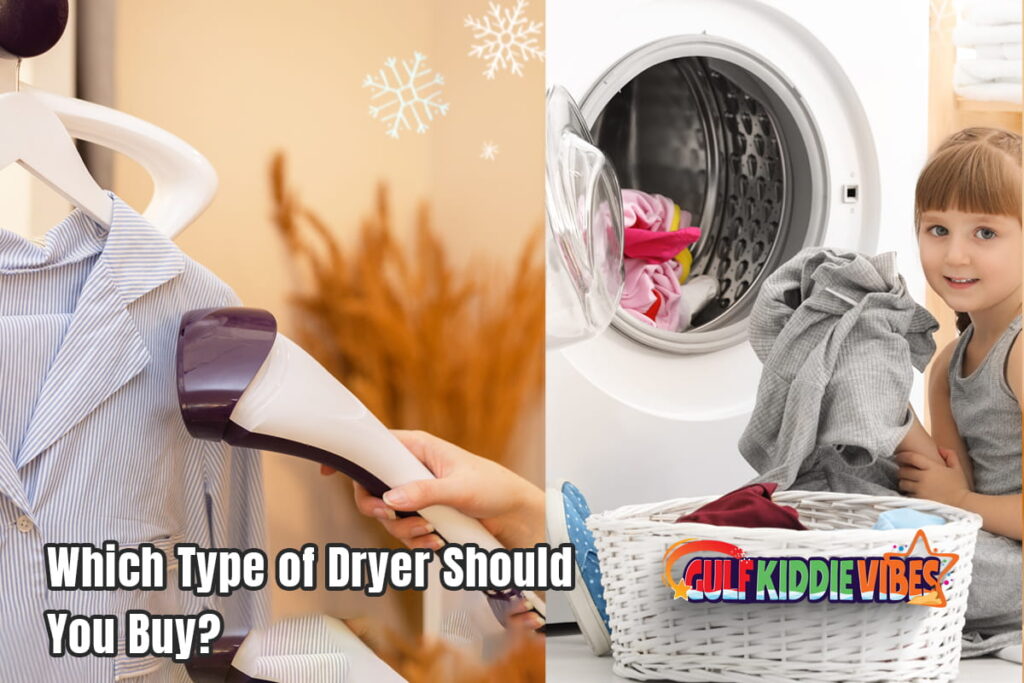
When you’re thinking about getting a clothes dryer, the first thing to understand is that not all dryers work the same way. Some pull air through your home, others trap moisture, and some use a completely different method that costs way less to run.
The most common type you’ll find is a vented dryer. This is what most homes have because they’ve been around forever and are cheap up front. Basically, they blast hot air through your clothes and push all that wet air out through a vent to the outside.
The good part is that your clothes dry fast, usually in 30 to 45 minutes. But if you have delicate fabrics like silk or athletic wear with elastic, the high heat can damage them over time. That’s why we talked about low-heat drying options in our guide to washing synthetic fabrics. Vented dryers aren’t great for those materials if you use them constantly.
Then there are condenser dryers. These don’t need a vent to your outside wall, which is huge if you live in an apartment or your laundry room is in the middle of your home. Instead, they collect the moisture from your clothes and dump it into a tank you have to empty. They use less heat than vented dryers, so your clothes last longer.
But they take longer to dry your clothes, sometimes up to two hours. If you’re juggling kids’ schedules and need to get laundry done fast, this gets frustrating. They also cost more upfront.
Heat pump dryers are newer, and they use way less energy than other types. These use way less energy than the other two types because they recycle hot air instead of constantly making new hot air.
Your electricity bill goes down noticeably. The downside is they’re slow, sometimes taking three hours or more, and they cost a lot more when you buy them. But if you’ve got delicate fabrics or you’re worried about your electric bill, they might pay for themselves over time. They’re especially good for cotton and fabrics that can handle slower drying without damage.
Gas versus electric is a whole separate decision. Gas dryers heat up quicker and cost less to run per load, but only if your home already has a gas line. They also need proper venting and installation, which can add to your costs upfront.
Electric dryers work almost anywhere and are simpler to set up, but they cost a bit more per load to run. Most families just go with whatever their home already has because switching is complicated and expensive.

Once you’ve decided which type of dryer makes sense for your family, the next step is figuring out which features actually matter. Modern dryers have lots of fancy features. Some are useful, most aren’t. Let’s focus on what actually helps.
This one seems obvious, but people get it wrong all the time. If you have kids, you’re probably doing massive loads. Socks everywhere, sports uniforms, bedding, towels. A small dryer means you’re running it constantly, which wastes time and energy.
Most dryers come in two sizes: standard (around 4.5 to 5 cubic feet) or large (5.5 to 5.8 cubic feet). If your family is more than three people, go for the larger size. You’ll fit a whole week’s worth of clothes in one load instead of running it five times. The capacity also matters when you’re drying bulky stuff like comforters or winter coats. A small dryer just won’t handle it well.
Before you buy, measure your space. You don’t want to bring home a dryer that doesn’t fit your laundry room or the space next to your washing machine.
Running a dryer costs money, and some use way more energy than others. Heat pump dryers cost more to buy, but they’re cheaper to run. An older vented dryer might cost 3 to 5 AED per load. A heat pump dryer costs around 1 to 2 AED per load.
If you’re running five loads a week, that’s a difference of 50 to 100 AED a month. Over five years, that adds up to 3,000 to 6,000 AED in savings. So if a heat pump dryer costs 1,500 AED more than a vented one, it actually pays for itself.
Look for the energy label on the dryer. It tells you the estimated yearly cost to run it. That’s your real number, not what the salesperson tells you.
Sensor drying is not as complicated as it sounds. The dryer just keeps checking if your clothes are still wet and switches off the moment they are done. It doesn’t need any timer or any guessing. Your clothes do not sit in the heat longer than they need to, which is better for the fabric and better for your electricity bill. Sensor drying helps prevent that. Plus, overdrying can sometimes set stains permanently, so if you’re dealing with tough marks on kids’ clothes, this feature helps protect the fabric while you work on removing those stains.
Honestly, this is one feature worth paying extra for. You’ll save money on energy, your clothes will last longer, and you won’t have to guess how long to set the timer. Most modern dryers have this now, even the cheaper ones.
Some dryers sound like a jet engine. If your laundry room is near bedrooms or your living space, noise can ruin your kids’ sleep. You don’t want to run laundry at night and wake up the whole house.
Look for the decibel rating. Quieter dryers are around 70 to 75 decibels. Louder ones can hit 80 to 85 decibels. That might not sound like a huge difference, but it is. If the dryer is in a finished basement near where you watch TV or relax, quieter is worth it. If it’s in a garage far from living spaces, it doesn’t matter as much.
If you have young kids, a child lock is essential. You don’t want toddlers opening a hot dryer door and burning themselves. Most modern dryers have a lock button that prevents the door from opening unless you unlock it first. This should be on your must-have list, not optional.
Some dryers also have a cool-down cycle at the end, which lowers the temperature; it’s safer if kids touch it. It’s a small feature, but it’s actually a thoughtful design.
Dryers come with all kinds of extra buttons: steam refresh, sanitize cycles, WiFi connectivity to your phone, auto-restart, wrinkle guards. Some are useful. Some are just expensive marketing.
Steam refresh is actually helpful. If you forgot to take clothes out and they’re wrinkled, a quick steam cycle freshens them up without rewashing. That saves time when you’re in a rush. Sanitize cycles are good if someone in your family has sensitive skin, allergies, or wears sensory-friendly clothing that needs extra care. But honestly, you can also just run a hot load.
That’s nice if you want to start your dryer from another room, you can use WiFi and app controls, but it’s not a have-to feature. Don’t pay $300 extra just for that feature. Wrinkle guard is helpful if you forget about your laundry. The dryer tumbles the clothes a bit after it’s done, so they don’t wrinkle.
Pick the features that solve real problems in your life, not the ones that look cool in the showroom.

You’re getting close to making a decision, but before you head to the store or start clicking “buy now” online, let’s talk about the practical side of shopping. This is where a lot of people make mistakes that cost them money down the road.
In the UAE and wider Gulf region, modern clothes dryers usually start around 1,500–1,800 AED for basic condenser or entry-level models, while more efficient heat pump dryers tend to sit in the 2,000–3,000 AED range. For example, an 8 kg Whirlpool heat pump dryer is typically around ~1,800–1,900 AED, a popular Beko 10 kg heat pump model is around ~2,400 AED, and mid-range Samsung heat pump dryers are usually ~2,000–2,700 AED or so in local retail.
A cheaper dryer costs less upfront, but it usually uses more electricity each month, especially in the Gulf, where dryers are used often due to humidity and apartment living. A heat pump dryer costs more at first, but it saves energy over time and can reduce your electricity bills if you plan to stay in your home for several years. For most families, spending around 1,800 to 2,800 AED is a practical balance between price, capacity, and efficiency.
This sounds simple, but it trips people up constantly. You find the perfect dryer online, it arrives, and suddenly it doesn’t fit in your laundry room or next to your washing machine.
Before you buy anything, measure your space. Write down the height, width, and depth of where you’re planning to put the dryer. Also, check if there are any pipes, outlets, or vents nearby that might get in the way. If you’re planning a gas dryer, you need a gas line close enough. For vented dryers, you need access to an outside wall or duct.
Some apartments and smaller homes don’t have room for a standard dryer next to a washing machine. In that case, you might need a condenser or heat pump dryer because they don’t require outside venting. Or you could look at compact dryers, though they’re smaller and you’ll run more loads. Think about your actual space before you fall in love with a model.
This is the number that matters most, and most people ignore it completely. Let’s do the math.
Different dryer types cost different amounts to run per load:
If you do five loads a week, a vented dryer costs you around 90 to 120 AED per month. A heat pump dryer costs about 30 to 50 AED per month. That’s a difference of 60 to 70 AED every single month.
A heat pump dryer might cost 1,000 to 1,500 AED more upfront. But if you’re saving 60 AED a month on electricity, you’ll make that money back in less than two years. After that, you’re just saving money every month.
Check the energy label on any dryer before you buy it. It shows the estimated yearly running cost. That number tells you what you’ll actually spend, not just what you pay at the store.
You’ll see dozens of brands in stores and online. Some have been around for decades. Others are newer. So which ones actually hold up?
Brands like Bosch, Siemens, Electrolux, and LG are known for reliability and good customer service in the Gulf region. They’re not always the cheapest, but parts are available when something breaks, and service centers can fix them quickly. That matters more than saving 200 AED upfront.
Check reviews online, but be smart about it. Read a few reviews that mention long-term use, not just “it arrived on time.” Ask friends and neighbors what they have and if they’re happy with it. Talk to service technicians if you can. They’ll tell you which brands they see breaking down and which ones last.
Also, check the warranty. A good warranty should cover at least two years for parts and labor. Some brands offer longer warranties if you register your dryer. That’s worth doing because it protects you if something goes wrong.
One more thing: buy from a store that will deliver and install it properly. A cheap online deal means nothing if the dryer arrives damaged or installed incorrectly. Local appliance shops in your area often provide better installation service than big box stores.

People rush into buying a dryer without thinking it through. Here are the mistakes you should avoid so you don’t end up with a dryer that doesn’t fit your life or damages your family’s clothes.
We’ve covered how to wash different fabrics properly, but drying matters just as much. A heat pump or condenser dryer is gentler and keeps clothes lasting longer. That saves money on replacing worn-out wardrobe essentials for kids.
Most decent dryers will run fine for 10 to 13 years if you take proper care of them. Heat pump dryers tend to hold up even longer since they do not work as hard. If you clean the vent regularly, the machine performs well for a long time. .
Yes, but make sure your washing machine has done a proper spin cycle first. Less water in the clothes means less time in the dryer and lower energy use. Just do not stuff it too full, or some clothes will come out still damp.
Yes. Clean the lint trap after every load. A clogged filter makes drying slower, wastes energy, and is a fire hazard. Takes 10 seconds and makes a big difference.
You now know the types, features, costs, and common mistakes. So here’s what to do: write down your family’s needs. How many loads weekly? What’s your budget? Do you need gentle drying for delicate clothes? Once you answer these, the right dryer becomes clear.
A dryer that costs more upfront but runs cheaply and lasts longer is always smarter. Take your time, compare options, and decide with confidence.
Your laundry routine will be easier, your clothes will last longer, and your bills will be predictable.